

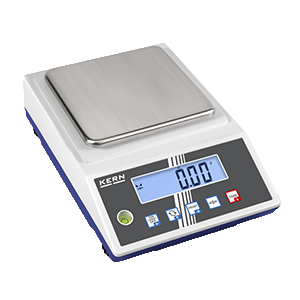
The KERN PCB IoT-Line Compact Laboratory Balance series sets the standard for modern laboratory weighing. Designed for Industry 4.0 environments, these advanced balances provide high precision, flexible connectivity, and smart data integration for laboratories, research facilities, and industrial applications.
With weighing capacities ranging from 200 g to 10 kg and a readability of 0.001 g, the PCB series delivers accurate and reliable results for demanding weighing tasks. Integrated IoT connectivity and modular interface options allow seamless communication with computers, networks, printers, and mobile devices.
These compact laboratory balances are ideal for laboratory analysis, research and development, education, and industrial quality control.
Key Features of the KERN PCB IoT Laboratory Balance
Industry 4.0 Connectivity
The integrated KERN Universal Port (KUP) allows easy connection of interface adapters, including:
-
RS-232
-
USB
-
Bluetooth
-
Ethernet
-
WiFi
-
Analogue interfaces
Adapters can be plugged in without opening the balance housing, allowing quick upgrades and flexible integration into digital laboratory systems.
Smart Data Communication
The KERN Communication Protocol (KCP) enables:
-
Remote control of the balance
-
Data transmission to external devices
-
Integration with laboratory management systems
Weighing data can be transmitted directly to PCs, smartphones, tablets, printers, and networks.
Precision and Stability
The PCB series features an Anti-Shock weighing system that minimizes vibrations, ensuring fast stabilization and reliable weighing results.
Stabilization times are typically around 3 seconds, enabling efficient laboratory workflows.
Flexible Weighing Functions
The balances support a wide range of laboratory applications with functions such as:
-
Checkweighing with visual and acoustic signals
-
Recipe weighing for multi-component mixtures
-
PRE-TARE function for container weight subtraction
-
Programmable weighing units (e.g., g/m, g/m²)
-
Counting mode (PCS)
-
Percentage weighing
These features make the PCB series ideal for sample preparation, formulation, and process control.
User-Friendly Operation
The balances feature a simplified and standardized operating concept, making them suitable for both experienced technicians and educational environments.
Each balance is supplied with a protective working cover to enhance durability during daily laboratory use.
Recipe Balance Models (PCB-Rez Series)
The PCB-Rez recipe combines the KERN PCB laboratory balance with EasyTouch formulation software, creating a powerful system for pharmaceutical, chemical, and food production environments.
Advanced Recipe Management
Using EasyTouch software, users can:
-
Create and store secure recipes
-
Assign recipes to specific user roles
-
Follow the guided formulation steps
-
Use optical and acoustic dosing assistance
Error Prevention and Resource Protection
The system includes advanced safeguards such as:
-
Detection of overfilling
-
Automatic recipe adjustment when correction is required
-
Prevention of incorrect ingredient selection
This ensures maximum accuracy and minimal material waste, which is particularly important when handling expensive or limited resources.
Each recipe balance bundle includes:
-
KERN PCB laboratory balance
-
EasyTouch Base software
-
EasyTouch Formulation module
-
KUP-03 USB interface adapter
Available Models in the PCB Series
The KERN PCB range includes multiple models to suit different weighing requirements:
| Model | Max Capacity | Readability |
|---|---|---|
| PCB 200-3 | 200 g | 0.001 g |
| PCB 300-3 | 360 g | 0.001 g |
| PCB 300-2 | 300 g | 0.01 g |
| PCB 1000-2 | 1200 g | 0.01 g |
| PCB 2000-1 | 2000 g | 0.1 g |
| PCB 3000-2 | 3600 g | 0.01 g |
| PCB 6000-1 | 6000 g | 0.1 g |
| PCB 6000-0 | 6000 g | 1 g |
| PCB 10000-1 | 10 kg | 0.0001 kg |
Specialised recipe balance versions (PCB-Rez) are available for formulation applications.
Typical Applications
KERN PCB laboratory balances are widely used in:
-
Scientific laboratories
-
Educational institutions
-
Research and development facilities
-
Industrial quality control
-
Pharmaceutical formulation
-
Chemical processing
-
Food production laboratories